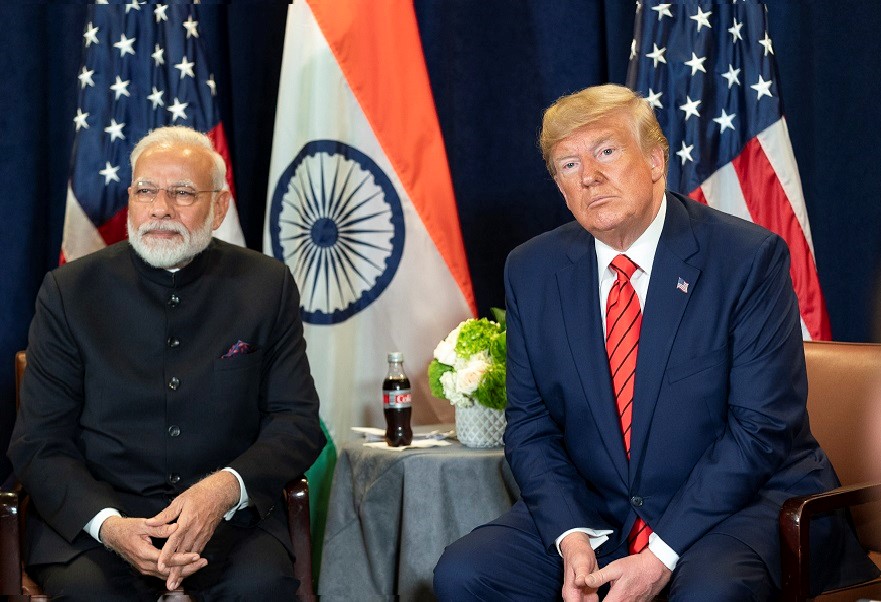
US leader Trump and his family officially made their first visit to India on 24-25 February. Trump’s visit to India was very enthusiastic. Trump, whose first stop was Ahmedabad, was greeted in a rather gaudy manner by a crowd of over hundreds of thousands in the world’s largest cricket stadium, the Motera Stadium. It is also necessary to add to this gaudy the costs of security measures (Like a $ 3 billion communication system) taken before the US leader arrives, and the costs of hastily erected walls to hide the slums along the 22 km road show. On the other hand, Trump is a world leader who is loved by Indians. In fact, he is loved by the far-right Hindus for saying that he will eradicate Islamic terrorism. Sena leader Vishnu Gupta even stated that they are fans of Trump. From the perspective of Trump, it is seen that he attaches great importance to India. With the arrival of the current US leader in power, the trade of the USA with India increased by more than 40%. Also, compared to other US leaders, the Trump-era US-India relations are in a very good condition. Because, considering the Cold War period, it is seen as an important development that India-USA relations reach this point.
For the USA, India constitutes the most important part of the Indo-Pacific region as the 5th largest economy in the world. In addition, the USA is one of India’s largest import partners, and bi-directional trade in goods and services has exceeded $ 142 billion, according to 2018 data. Although India’s economic growth has slowed in recent years, the increasing need for energy as one of the most important economic powers in the world and growing gradually increases the appetite of the USA. Energy imports from the USA to India increased by 500% in 2016, and this corresponds to approximately $ 7 billion. The relations between the two countries have been very strained due to commercial issues in recent years. In contrast, with Trump’s first official visit, which was held with the intention of gathering tense relations, the basis of bilateral relations was based on the tradition of democracy, common strategic interest and lasting bond between the two communities. Welcomed with a big ceremony, Trump praised India and Modi abundantly in his speech at Motera Stadium. In addition, economy, energy, defense and security were also among the main topics of this visit. Topics such as removing bureaucratic barriers to trade and cooperation in space researches were the agenda items of this visit. Although the USA, which sees India as a big market, aimed to sign a big trade agreement on this occasion, there was only a significant improvement in the field of defense. The two countries signed a $ 3.4 billion military helicopter contract, the most recent of major US arms sales to India in recent years. In addition, it is possible to predict that commercial tensions between the two countries will continue, at least in some areas.
The biggest problem between India and the United States is trade disagreement. In this visit, Trump said that Modi was a “very difficult compromise”, as he underlined this discomfort. The two stated that the defence agreement to be held in order to leave these disagreements behind is the biggest agreement. However, the tension that has been growing in recent years complicates the situation even more. In addition, although there are common interest statements, the deep strategic interest differences between the two countries continue to feed trade dispute between India and the USA. The subject that the USA complains the most is the tax and tariff practices applied by India. Trump, by calling India as the “tariff king”, has cynically expressed his discomfort in the past years. The USA, which does not find the tariff laws of India fair, puts pressure on India for ease of trade.
As Trump’s visit did not sign a large trade agreement, there were some irreconcilable points in areas such as data localization, motorcycle, food, medicine, e-commerce and defense technology. For example, the Trump government asked India to import more dairy products from the United States. India, on the other hand, asked for a certificate that the products in question were not obtained from animals fed with internal organs, dried animal blood and ruminant tissue. However, this demand made it almost impossible for the USA to export dairy products to India due to the content of the products. In terms of India, this also meant protecting millions of peasant Indian producer in the dairy industry. The USA did not pressure on dairy products. In return, however, the risk of increasing the possibility of closing the H1B visa route to India due to Indians affected by the current visa application of the United States is great. Seeing that there are big obstacles in terms of trade with India, the USA continues to insist, even though it cannot apply much pressure. The United States, which has removed India from the GSP (Generalized System of Preferences system) due to the commercial dispute between the two years ago, insists that India sign an additional trade agreement of $ 5-6 billion in order to benefit from this privilege again.
In defense and security issues, the permanent discourse of the two leaders was emphasized again through this trip. Because while both states supported an open and free Indo-Pacific region, they repeated the promise to fight against radical Islamic terrorism. Radical Islamic terrorism is a very sensitive issue for both countries. Because, behind the border security policies implemented by the USA in recent years, this issue comes to the fore. For this very reason, Trump has not made any comments on the CAA, which has been on the agenda of India for the past few months. He supported the last step of India about the law by saying that every nation has the right to secure and control its borders. Nor did he comment on the anti-CAA protests that erupted in Delhi during his days.
From a global perspective, the U.S. wants India to take more initiative to ensure the security of Indo-Pacific. The USA wants India, which it supports as a power against China, to become the outpost of the region. For this reason, the US wants a strong India, with a competent army, that will ensure peace stability and rule-based order in the region. Under these policies, the United States, which focused on India instead of Pakistan in South Asia, helped India, which was attacked by Pulwama in 2019, and showed great support for the recognition of terrorists operating outside Pakistan by UN. Besides, he wants India to take on responsibility not only as a balancing force against China, but also after the American troops withdraw from Afghanistan, to ensure peace and security. However, India does not take a clear stance on both issues. Because India does not want to play such a role against China. For India, which has made significant progress in its relations with China, it is not an issue that it can accept without questioning such competition. India, which has been trying to maintain its independence and non-aligned since 1947, seems to have preferred to continue this stance in the same way. Due to the current attitudes of India, Pakistan is still important for the USA. Pakistan will play an crucial role in the withdrawal process from Afghanistan. It is precisely for these reasons that Trump, who did not visit to Pakistan in terms of the lack of tension in his trip to India, did not return without getting a pat on the back of Pakistan, which played an important role for the USA. Stating that the United States is working with Pakistan on terrorists in the region, Trump expressed that he can do whatever he can to solve the Kashmir problem because he knows the leaders of both countries and has a good friendship relationship. With this discourse, he disturbed India.
On the other hand, for India, the US is not yet in a position it can fully trust. For the USA, while casting roles to India in the Indo-Pacific, it forces India to buy the F-16, the old technology fighter plane. This proves that in the eyes of the country, the USA is reluctant to transfer high military technology to them. Although the F-16s, with the technology renewed and used by Pakistan for 40 years, are an important war technology that can be imported to India in terms of the USA, this attitude of the USA gives important signals to question the strategic partnership between the two countries for India who wants to have modern war weapon technology. For this reason, India does not want to submit to the United States for modern defense technologies that it can easily obtain from Russia, Israel and France. Because, many attempts regarding the defense technology and trade of India with the USA have been fruitless. In addition, the submission of the current Indian leader to such pressure would damage his own image in his country. On the other hand, the USA supported China against Russia during the Cold War. The US, who believed that the aid he provided at that time had a significant share in China’s journey to the present, does not seem to want to repeat the same “mistake” today. When all these are evaluated, it can be interpreted that the USA, which wants to maintain its superpower position in the global arena, does not want to provide extra help to India.
Another issue is that the USA’s Iran policy is disrupting its relations with the country, which is India’s gateway to Central Asia. The American government does not take good care of its relations with Iran, which is an important source of hydrocarbon for India and its oil and gas import partner, which it supplies cheaper than the USA. In addition, the US enforcement law against countries trading with Iran, Russia and North Korea (CAATSA) leaves India in a difficult situation. Although the USA wishes to be the number one import partner of India in every field, both countries do not have common interests when considering India’s relations with Iran, Russia and Pakistan. Despite all this, India prefers to improve its relations with the United States on different topics than trade.
As a result, despite the close relations of Trump and Modi, there are deep strategic differences at the core of the US-India relations. In addition, the USA does not act as a natural ally to India. The words Trump made during the trip show that the USA is still not taking India seriously enough. For India, the most important plus of Trump’s trip is that it has signaled that it will remain a key actor in the international arena by demonstrating that it has managed to attract the attention of the most important leader in the world despite the decreasing growth rates and some image damaging events in the country.